
Required Viewing
For DFSS, we are required to watch media so that we are able to have a wider contextual knowledge of the world in which we will eventually go on to work in. Here is all my typed work for this part of the course in reverse viewing order.
Year 2

CARMEN
★★★★/5
Unfortunately I was not able to attend the Contextual Studies lecture this week, which I was really disappointed about. So I decided to go into Carmen – which I knew was the next film from the online list – before catching up on the lecture. I’m so glad I went in blind! I’m a big fan of dance movies like Step Up, which came out when I was a kid, and it’s been really cool to see where the DNA of those movies came from in this module.
The reason why I liked Carmen so much is probably the thing that least gels with everything I’ve learned with DFTV and decorating sets in visuals – how barren they are. But that only makes it serve as a backdrop. It’s a pretty unusual stage, a dance studio, and yet here, Saura directs his actors. I’ve been thinking a lot lately about the term ‘performer’. I think it’s no coincidence that the plot revolves around a rehearsal. Rhythm and dance and around and around and around. It’s like poetry. Not just the dancing, either – the mirrors, the camera work, the love, the passion.
I used to follow ice skating pretty closely, especially the work of the Olympic duo Virtue and Moir. I’m so glad I got to revisit their Carmen routine from a few years ago, after seeing this. It’s really nice to connect with something like that so blindly.
And flamenco. In jeans. I mean, hello?

One From the Heart
★★★★/5
I thought that One From the Heart was a valuable viewing for DFTV. Being able to see a set world that was created fully in a studio gave the film a kind of texture that seemed fully made and realised, technically.
I think that the plot kind of suffered from the film being a sensory experience, but I’m a massive fan of melodrama as a whole so I liked it. I thought it felt like the fireworks on the cover; I thought that the Tom Waits soundtrack was excellent and, well. The control of the spectacle. The lecture that was delivered on Ford Coppola and the fall of the production company in creating and almost living in this world, with the wild set parties.
This product that came from that of a film that can’t really be separated from the process that made it. One from the Heart was better knowing more about the background. But I can’t help but wonder how I would feel if I went in fully blind. I would probably enjoy it just as much. It feels alive.

Koyaanisqatsi
★★★½/5
I sort of want to leave Koyaanisqatsi to review until after I see it projected, because I don’t think that watching it on my laptop is the best way to watch it. But I do agree that the montage was mesmerising. I can see how documentaries like Planet Earth have taken inspiration from the direction of the film in how they present nature.
I studied English Literature as an A Level and as a part of that we looked into how the romantics viewed technological advancement during the industrial revolution and how it scarred nature. I think that Koyaanisqatsi has a similar outlook on reacting to change in the postmodern era. To that, I think it really is a proper postmodern film – it is a reactionary piece.
There's a theory by Alvin Toffler called 'future shock' which suggests that due to there being so many changes in technology at one time humanity is forever scarred from constantly moving forward. I think that in Koyaanisqatsi, Reggio argues that the same thing is instead true in nature: that we are the ones dealing harm to it that can never be healed properly.

HAIR
★★½/5
I recently read a novel called ‘The Overstory’ which was all about protesting deforestation and tree-felling for logging in the 1980s. Pairing this with the lecture on protest media in theatre and film meant that my watch of HAIR was really interesting. I’m not particularly sure that it was my favourite musical that we’ve watched this year, but I do think that it was a valuable viewing. The songs are great, though.
I did some research after the film and I found that the storyline that is in the film isn’t in the musical to the same degree. I think I’d like to do some further research into the original stage musical to understand the final product. I think that the wildness and how sort of untamed the movie is actually kind of fits with the subject matter.

All That Jazz
★★★½/5
The first clip I watched of All That Jazz was in Martin Scorcese’s documentary A Personal Journey, which we watched the first part of in DFTV. I was really looking forward to seeing the full film because of this. I think with the extra information I know now about Bob Fosse and his work in film it has made it really interesting to watch it in full now.
Overall, I think the biggest impression on my visual language that All That Jazz has left is the sort of continuation from Cabaret – the sweat, the lights of the stage, the common language of show business. But it also feels a lot more personal than Cabaret – a self portrait rather than a skewing. It’s extremely self-aware that ‘showtime’ is exactly that – putting on a show.
A tornado of a show, but a show that ends. I think that my favourite set piece was the hospital scene because of that – the culmination of all the whirlwind emotions that the film offers.

Saturday Night Fever
★★½/5
I think that especially after the lecture on disco that we had Saturday Night Fever was the perfect movie to watch! I can see why a lot of films have since paid homage to the costumes and the dichotomy between the club scenes and the street scenes was so interesting. I liked how the two felt like different worlds and the club scenes felt unreal/like fantasy, which fit with the theme of Tony’s escape from daily life.
I have to point out that it felt really uncomfortable to watch the scene with the sexual assault. I also was thinking a lot about the part in the lecture where it was pointed out that Saturday Night Fever is a mainstream version of disco for middle America, as a lot of the main cast did not represent the true voices that formed the original disco subculture – straight, white and sanitised.
There is a lot of conversation in today’s postmodern era of film about representation and I found myself watching Saturday Night Fever with that lens more than an eye to the production design. It's weird, off-putting, that Fever presents itself as an explosion of expression and dance while nothing is said about where that comes from, other than the character motivations in the film which are -- as it's a fictional story -- fictional. In presenting itself as a fantasy, Saturday Night Fever fails to pull back the final layer on what it's aiming to put an eye on.

Rocky Horror Picture Show
★★★★/5
I really enjoyed watching Rocky Horror. I thought that it was so nice to see everyone who really likes the film get excited about seeing it again. My main frame of reference with Rocky Horror is the Glee special, so it was good to see where it all came from. I thought that Susan Sarandon in particular was so good in it as Janet – she really stood out.
I loved the visual differences between the costumes of the Weisses and the convention. I thought that the repression of the Weisses was well-communicated and that the science-fiction B-movie presentation of the production design, cribbing props and sets from other movies as in the lecture enhanced the story of that repression essentially getting ripped apart. It isn’t a quiet film – I don’t think Rocky Horror could be quiet if it tried.
I have been inspired to go on to research the work of Richard O'Brien, and also how plays got adapted into movie musicals and the newer trend of movies being adapted into stage musicals.

American Graffiti
★★★½/5
Wedged in-between the studio musical and the MTV era, American Graffiti exists as a true representation of memory and sense memory of Lucas’ childhood. The almost mythic character of ‘Wolfman Jack’ – Graffiti’s Wizard of Oz – is not a betrayal when the curtain is pulled back, but another layer. Humanist layers are important in Graffiti; the title card at the end of the film touches on the main character’s later lives. But as a period piece that is set ten years earlier than its release, the audience is left asking itself – why was this part not filmed? There are two answers: that Graffiti serves to encapsulate one part of a life where characters come together, and the answer that the audience finds without thinking – that this is a film about cars and music and childhood, and what we leave behind.
I don’t know how useful I found American Graffiti for my contextual studies work, but I think for thinking about main module construction and design it was really useful. Since the film is centred around the world of car cruising I was able to think a lot about how action vehicles are used and hired for film production.
I also thought that it was pretty interesting to see work from George Lucas pre-Star Wars. Removed from the genre trappings of space opera and fantasy, I think that his creative vision is so much more grounded in his lens of small town America in the 1960s. I have been inspired to go on to research how Lucas’ vision evolved to eventually encompass the major world of Star Wars from this, inspired by his childhood versus being inspired by his children.

Cabaret
★★★/5
I think it’s really interesting to see the portrayal of club settings in movies and their influence on real life places. Another example that comes to mind is the club scenes in Ridley Scott’s Blade Runner – it is a nightclub in a film. I think that the ‘true black’ of the film stock used in Cabaret and Blade Runner really works well to emphasise the darkness of the sets and connote an overall atmosphere. You can almost smell the places – the sweat, the alcohol, the cigarettes. The contrast between Cabaret’s ‘dream world’ and its portrayal of real life is divorced, but the separation bleeds into the fact that this is a real job and real life for the characters within. It’s very Tolstoy.
I can see why Cabaret was chosen as a part of our required viewings. It’s really useful for looking at portrayals of clubs and conveying atmosphere through production design. I didn’t really click with the film on a personal level, though – I can see myself going back to it for the purpose of pulling from the visuals of the film in my own work, but not to watch it for fun. I think it might be because I’ve read the novel it’s based on, Goodbye to Berlin.
Talking to my coursemates after the viewings helped me come to the opinion that the sets that weren’t a part of the ‘cabaret’ club world – Sally and Brian’s apartment, Max’s country estate – were more compelling and believable to me as a part of the world of the film. (I think that analysing the parts that I didn’t like will help me to become a better designer in the long run.)
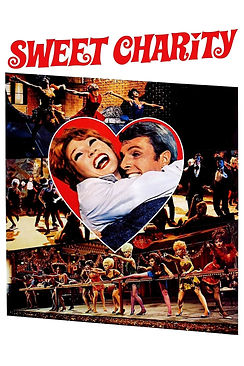
Sweet Charity
★★★★/5
I thought that watching Sweet Charity was especially valuable for DFTV. I did feel that the plot was predictable; I enjoyed it though.
I really liked the atmosphere that was created. I also really enjoyed the bright colours of the costumes and the dichotomy of the grungy weathered sets. I have begun to notice the common thread of colour theming in musicals and how that can be used to tell a story. This trend has continued today into films like La La Land (Someone in the Crowd comes to mind.) I would like to go on to research more about Bob Fosse and to analyse how the original stage set is reflected in the production design for the film.
I really want to highlight the ‘musical’ sections of the film (for example the rooftop and the actors club scene) within my review as they really left a big impression on me. I really could see how the choices made with the production design of the film has led to trends nowadays in music videos such as Dangerous Woman, Shake it Off and Single Ladies. Really enjoyed it!

West Side Memories
★★½/5
A look back! I wasn’t sure how valuable I found West Side Memories to be for my production design studies. This is possibly because I haven’t seen the original film, which I want to rectify as soon as possible from seeing the clips from this feature.
I think perhaps it would have been more effective for me to view the actual film to feed my visual knowledge as I was really interested in the theatre-like framing of the film and how it changed compared to the version of West Side Story I have seen, the 2021 Spielberg version which as stated in Contextual Studies this week aimed to break it out into a 3D world.
I have been inspired to go on to research the work of Boris Levin as production designer. As the production designer for this film as well as the Sound of Music and Anatomy of a Murder I really like his use of palette and how his work sort of toes the line between realism and abstract work.

That's Entertainment!
★★★½/5
My impression of That’s Entertainment is that it was really informative. I really enjoyed this look at MGM’s past and also the historical context that we learned that led to the creation of this documentary. A lot of the sets were really high budget and to see the excess and extravagance mixed with how apparent it was that these things were at the forefront of innovation was, I think, really useful and valuable.
I have gained some great additions to my visual language such as being able to see and internalise the work of the art directors and production designers of MGM. It was also great in making me excited for the required viewings to come and re-familiarise myself with some techniques that I first learned about last year.
I have been inspired to go on and research more about the MGM musicals and their respective art directions. I would especially like to investigate An American in Paris due to its similarity to La La Land which obviously pulls from it.
Year 1

The Elephant Man
★★½/5
The Elephant Man was difficult to watch. I think that this is a film that you have to return to after a couple of years to see new things. I think Lynch’s direction was very interesting, especially that he sort of made the audience feel complicit in having Merrick as a performer. I thought it was quite successful in doing that. Of Lynch’s other work I’ve only seen Twin Peaks, but I think he’s good at framing his interest in surrealism with realistic dialogue and characters.
I have been inspired to go on to research how weather affects sets when it is called for in the script, and how crazy weather days can affect shoots. There are quite a few scenes in The Elephant Man that take place in the rain. Rain trucks and rain rigs can be used to create consistent rain, and backlighting that rain highlights the drops to create depth and dimension.
I’m not sure if it was valuable to me in studying-production-design wise, but I do think it's valuable to add to my knowledge of cinematography and how historical stories have been adapted over the years. I thought that the makeup was really convincing and it’s a great example of how all departments can work together for a strong design output.

An Imitation of Life
★★★½/5
I really liked An Imitation of Life! I think that the way that the set changed over time along with the characters was a good addition to my visual language. I thought that the bubble-gum colours in the later house set being juxtaposed against the dark and light blues of the first apartment was very clever in being used to support Douglas Sirk’s critique of social and racial inequality.
The set didn’t just support the narrative but the themes as well, which I also really liked.
I thought this was valuable viewing because it was a great example of how production design adapted to filming in colour. It was also really nice to be able to see colour on a big projected screen.

The Man With the Golden Arm
★★★½/5
I thought that this was particularly valuable viewing for DFTV and Contextual Studies as it was able to give context to how taboo subjects were portrayed in film in the twentieth century such as drug addiction. Though now many films have been created that deal with this film, it was really interesting to see how different the attitudes were back then.
The title sequence from Saul Bass in particular was really striking to me. As I studied graphic design in college I thought that this was especially good at communicating the feel of the film before it even started. I thought it was a good match to the film. I have therefore been inspired to go on to research Saul Bass and his work.

The Night of the Hunter
★★★★/5
My impression of the Night of the Hunter was that it was a really impressive film. My favourite shot was the underwater shot and I loved the suspense and the tension that was able to be created. The humour really works as well.
I’ve been inspired to go on to research the history of the thriller in film. The Night of the Hunter shares a lot of aspects with modern thrillers like Gone Girl and I would be interested in seeing that evolution.
I thought that this was really valuable viewing due to the way that Charles Laughton utilised cinematography to emphasise the horror aspect of the film. I thought that the wide contrast between the shadows and the highlights almost made the picture look like photographs. It was a real thriller of a film and the production design really helped with that, making it feel really insidious with all the shadows that were cast.

La Belle et La Bête
★★★★/5
I think that Cocteau’s La Belle et La Bête was an extremely valuable viewing for DFTV. It was a little bit odd to be seated in the studio for this viewing instead of the lecture theatre, but I think I definitely prefer Cocteau’s version of the fairytale as compared to the Disney version. I thought it was really beautiful as I was watching it and it has stayed with me until this review.
I really admired how the gothic aesthetic was employed to create the atmosphere of the film. I also enjoyed seeing how practical effects like the moving torches on the wall were fully realised. I unfortunately don’t think that the makeup on the Beast’s face particularly holds up now. For a film in black-and-white, it left an impression of being colourful. I think the costume students are going to have a good time writing about this one.
I have been inspired to go on to research the connections and inspirations taken from this film to the Disney version. Before watching La Belle et La Bête, I assumed that Beauty and the Beast had been lifted straight from the fairy tale. It has become very apparent that this is not true.

The Third Man
★★/5
...This film didn’t really leave a big impression on me. I thought that the production design was quite good but I don’t think that it particularly evoked Vienna. The city seems quite sparse and empty. It felt like quite a slow film even though the editing was great. The score bothered me a lot as well.
I thought it was interesting how the plot twist was handled but I think that especially compared to 'The Scarlet Empress' the set design didn't particularly enhance the final product. Perhaps I just didn't click with the movie.

Citizen Kane
★★★½/5
I think that there’s a reason why Citizen Kane is regarded as the influential film that it is. I thought that this was especially valuable viewing as I’d never watched the movie before. I don’t feel like I can add anything new to the conversation when talking about the film, though, which I think is less of a remark on the art itself as it is a meta-narrative on the conversation that has been surrounding it since its release.
Art direction imitates life, but directors have imitated Welles’ approach for almost eighty years. I think it’s really interesting how the critical reaction to Citizen Kane is concerned less with the narrative of the film and more with the techniques used to make it and the mark that it has made on filmmakers that regard themselves as auteurs. To those that want to work in areas that are not involved with being ‘the director’, who is often seen as the sole contributor in the public eye towards a work, legacies like Citizen Kane can seem impenetrable to add new conversation about.
Many regard Citizen Kane as the best film full stop. I think that studying DFTV has lead me to disregard the idea of auteurism, as even though Welles directed, wrote and starred in Kane it is visibly apparent the other hard work that has been made by Van Nest Polglase and Edward Stevenson that has ensured that Citizen Kane has that spot in popular culture.

A Matter of Life and Death
★★★½/5
I think this was really valuable viewing just to see how production design and early visual effects worked together to create a whole other world. I thought that the decision to make all the fantasy scenes black and white while the real world was in technicolour was so creative. It made the ‘other world’ feel more like a fantasy. I’ve been inspired to go on to research the development of technicolour and how it has evolved into colour being the main output films are in.
I thought that A Matter of Life and Death was a really charming film. I found it a bit weird that the lawyer character chose ‘Americans from all walks of life’ for the jury but none of them were women, though. I think if it were made today that would be a good thing to modernise and not take away from the film at all.

The Scarlet Empress
★★★★/5
I was really blown away by The Scarlet Empress, not only by the art direction by the director Von Sternberg, but by the performances and particularly by Marlene Dietrich who played Catherine the Great in the film. No emperor -- only the Empress, indeed.
I thought that the gothic elements within the production design and the grandiose and sometimes overwhelming set decoration truly was a sight to behold. Everything flowed very well, from the direction to the art to the costumes to the acting -- it is a complete product from start to end.
An addition to my visual language I have gained from watching The Scarlet Empress is definitely a deep interest in the gothic-themed production design of the film. I really liked how decadent it was and how texture and interesting conceptual design could be used to create the world of the film. After watching, I researched the contemporary reaction to the film and discovered that it was not received well after its release due to the lavish sets and costumes. I have been inspired to go on to research how films during the Depression handled decadent production design on their respective budgets.

Zéro de Conduite
★★★★/5
Tweenage rebels, in 4:3 non-colour! I thought it was really interesting how many of the shots were framed in Zéro de Conduite -- this film, along with Metropolis, could be really useful when we move on to learning how to do storyboarding later on in the year.
I have been inspired to go on and research into the films this film has inspired. Already I can think of movies like Dead Poets Society (1989) and the St Trinian's series -- the idea of childhood (and teenage) rebellion against the system -- but there are most definitely more, as the characters of the 'teenage rebel' has become a stereotype in today's media, such as in recent TV series like Riverdale and Euphoria.
It would be good also to find out which directors are inspired by Vigo or use Conduite as a reference point in order to build a more connected and complete knowledge of film.
Vigo's full use of his space -- the 4:3 aspect ratio -- is quite effective, and it really reminds me of how Wes Anderson does the same thing with movies like the Grand Budapest Hotel. It makes me wonder what these shots would look like in widescreen! Overall, I thought that it was quite relevant to the pathway.

'Journey into Surrealist Film' Viewing Session
★★/5
Ants from hands. Also, baseball! Through watching the five clips -- Chien Andalou, Destino and Meshes of the Afternoon in full, as well as clips from Spellbound and Dumbo -- I have now become more familiar with surrealistic concepts and visuals. I have also gained more knowledge about how directors use things like body horror within surrealism and where that comes from as a concept.
I am very interested in finding out more about Disney and Dali's Destino -- I connected with that one the most, and an animation with a completion time of over sixty years must have a good story behind it. I found the mix of 3D animation and 2D traditional cell art really appealing and the love story between the man and the woman - each untouchable art to the other -- quite beautiful.
What stood out to me the most was the amount of body horror and psychological horror -- the feeling that something wasn't quite right. I think seeing surrealistic art in a moving medium has a different effect than in, for example, a painting -- you aren't left to reflect on only a single thing. I feel like I could use colour and movement in a similar way and apply it to make different results in my pathway.

The Winter's Tale (Live at The Barbican, 2017)
★★/5
If I could point out anything about Declan Donnellan's production of The Winter's Tale, it would be the moody lighting and the abstract sets. I enjoyed the production, but I didn't find it very useful for me personally as compared to other things from Contextual Studies like Metropolis from last week. Nick Ormerod's set decoration was excellent though and really fit with this representation of Shakespeare's A Winter's Tale. For example, the use of projection on the wall really appealed to me.
Through this viewing, it was easy to see how adaptation to stage differs from adaptation to screen -- choices like having a minimalistic set that allows for a lot of locations to be represented within A Winter's Tale may look different as compared to how a movie/TV version might tackle this, like having multiple locations in a shoot.
As for what I've been inspired to go on to research, I've always really liked modern-day interpretations of Shakespeare, so maybe I'll go on to find some more of them on screen -- She's The Man, Clueless, Romeo + Juliet (and the National Theatre Othello on stage) are all some of my favourites. I'm not sure if The Winter's Tale has has an adaptation to screen comparable to this one, but it would be interesting to find that out and compare the two if I could.

Metropolis
★★★★½/5
Whenever I watch Metropolis, I feel like I can pause at any moment and take in something new. The art direction works totally and tonally with the director's vision. I thought it was really interesting and honestly cool how miniatures and scenic painting was incorporated to create the world of the film. I can see how Metropolis set the stage for a more abstract design work compared to a more naturalistic one.
I was able afterwards to do some research into how in particular the miniatures were used -- I found out that the cinematographer, Eugen Schüfftan, developed a practical effect involving covering part of the camera with a mirror to effectively do what blue screen and the use of Unreal Engine and digital sets do now. I also really liked how the art directors (Hunte, Kettelhut and Vollbrecht) used designs inspired by contemporary skylines. It gives Metropolis a very real feel compared to what exists in cities in real life.
I would like to look at films that were inspired by the look and cinematography of this movie, of which I assume are loads. Although it was a silent film and in German, the story was pretty easy to understand and quite stylised at the same time, which is a problem I had when watching the Cabinet of Dr Caligari. Both have their strengths, though.
...The Maschinenmensch Will Return In: "GOLDFINGER"

The Cabinet of Dr Caligari
★★★½/5
Lights, camera, sleeping murderer, action! Watching The Cabinet of Dr Caligari, it was nice to see an example of production designers working together to create a singular vision. It really put into perspective the importance of a team. It was especially impressive to me as there was three production designers and you couldn't tell that they were separate artists.
You can really see how it affects other cinema going forward, being an arthouse classic. One example I can think of is David Lynch's Twin Peaks -- there was a moment at around 32 minutes that really reminded me of that series. I also was reminded of the cages in Planet of the Apes with the winding, angled set design. I thought that the use of colour in monochromatic film and use of reference to create a cohesive design language throughout the production design was done really well. I was previously aware of the use of colour in the film for emotion and lighting, but it was good to see it in action. The use of vignette to hide certain areas to emphasise performance and location probably intrigued me the most.
Overall, I think the production design and cinematography was really good, but I found it hard to follow the plot with it being in German. I think if I watched a version with subtitles I would have enjoyed it more.

Medea
★★★/5
I think that one of Medea's strengths as a film is the way that costume and production design work together to create a design language for it. As a DFTV student, what interested me was the really strong design motifs that run throughout the film. For example, though Iolcus and Corinth are two differing cities with two different approaches to religious rituals, it's quite good that they look fairly similar, as this is a period piece and they would have looked similar in real life. There is a very naturalistic quality to the film, which emphasises the tragedy the movie ultimately portrays.
I understand that it was adapted from a Euripidean tragedy -- it's impressive that such a story has been able to be condensed down into the medium. At times, I thought it was a little bit dense, but the visuals made up for it.
I have been inspired to go on to research more about the adaptation process from script to screen. I also thought it was really interesting that Dante Ferretti did the production design and set decoration for Medea -- I really enjoyed his work on Hugo so it was refreshing to see something else from him, especially something as visually strong as this film. There is a really interesting evolution between those two films in production design from Ferretti.

A Personal Journey with Martin Scorsese Through American Movies
★★★½/5
Martin Scorsese really knows his stuff! The documentary is a very comprehensive reference for a lot of genres and genre-defining films that I could go back to and pull from. After watching it, I have gained points of reference about different genres of American filmmaking, such as westerns and mafia movies, as well as how they have evolved in different eras over time.
I have been inspired to go on to research more about the idea of 'one for me, one for the studio' that Scorsese talks about in the documentary. The politics in Hollywood also interested me so I will be looking more into that. Perhaps the first part was the most entertaining for me personally -- I love musicals and learning more about their evolution was interesting -- but I can appreciate the other parts as well and probably will use them going forward.
For DFTV, I think that being able to see the evolution of sets (and the shared style identity of genres like westerns) was very interesting and also how a lot of the later films shown in the documentary referenced earlier ones.